
Imperial War Museum is the second museum I visited in London, during my trip. I’ve been to the branch in Manchester and I had high expectations from London. It was not as exciting as I thought it would be. There were screaming school children running around, on a school trip, instead of them being explained by stuff, as if it were a story, to make it interesting for them.
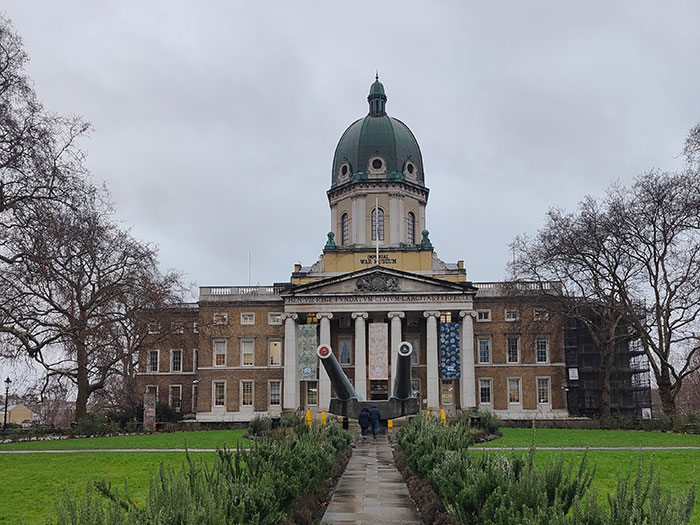
This museum is free, but others in the group aren’t. I think it is worth visiting, the cafe is nice and it’s a place very needed for a break or two as the museum is so big. There is something for everybody, but predictable too. There are details about the people from the colonies who fought with Britain in WW1 and WW2, but, somehow, only the UK as an empire. There is no mention of the soviet union being a colonizer. All that was soviet was only described as soviet, regardless if a person was born in Ukraine, for example. They wouldn’t call someone from India, British, even if it was part of the British empire. That’s correct, the problem is that they completely ignored other empires and colonizers. The curators at IWM even wrote Kyiv wrong, what a mess.
Another point is that the period after 1945 is seen as peaceful. Which is the current narrative, but museums like this one should challenge this perspective. 1945+ was so peaceful that thousands of nuclear bunkers were built and some are now museums. Politicians can talk as if the absence of war is peace, but historians should know better.
I picked a few highlights and shared some wider views of the galleries. There are 4 floors to see and it takes at least 5-6 hours to see all. It’s perfect for a day out, especially as it was rainy when we there.
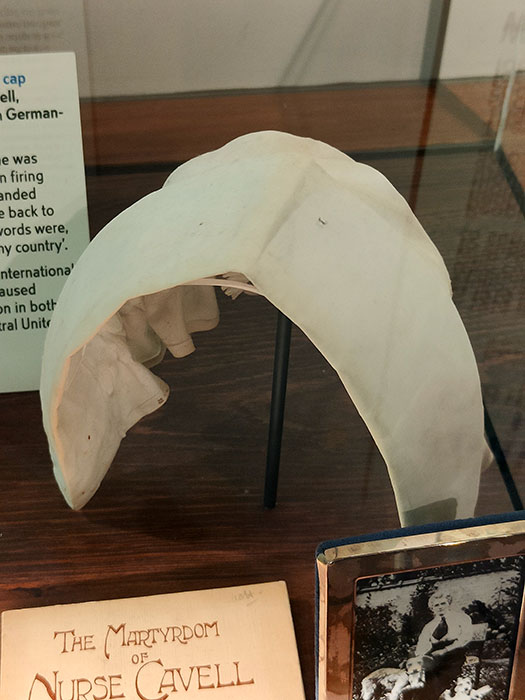
This is the cap of Nurse Edith Cavell, a British nurse who became famous during WW1 because she was executed by the Germans. She treated wounded soldiers from both sides, without any discrimination. She helped about 200 Allied soldiers escape from German-occupied Belgium. I used her photo in an essay a few years ago, so it was really lovely see her cap on display.
Nurse Cavell was commemorated with a statue, in 1920, in St Martin’s Place, very close to Trafalgar Square and National Portrait Gallery. Every time I’m around I stop to look at her statue.
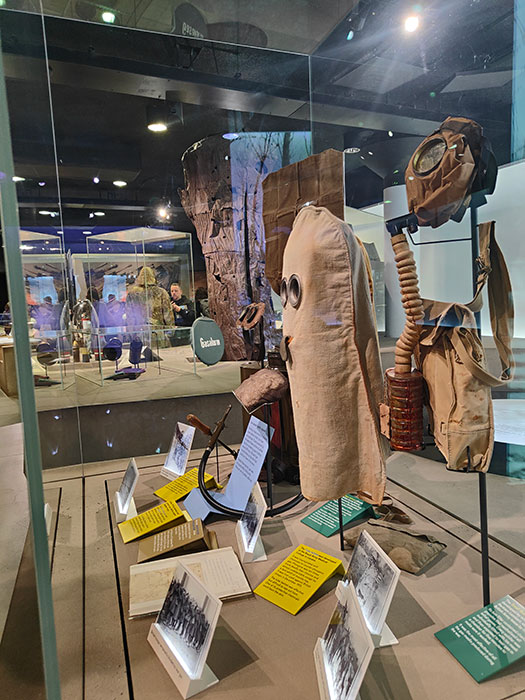
Gas masks from WW1. Even horses had masks. It seems, visiting these museums, that something like this can’t happen again… while it does, right now in Ukraine. The russians are using banned chemical agents in Ukraine and have done so for years. The Assad regime did the same in Syria.
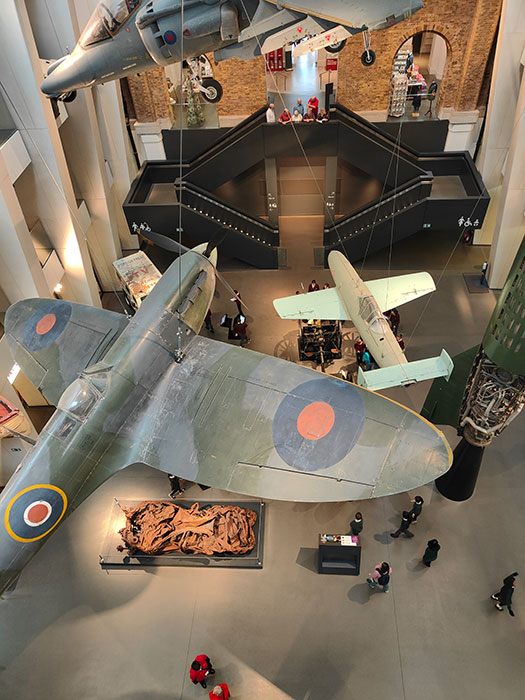
A view from above, with some planes, and a bombed car. The architecture of the museum is really good.
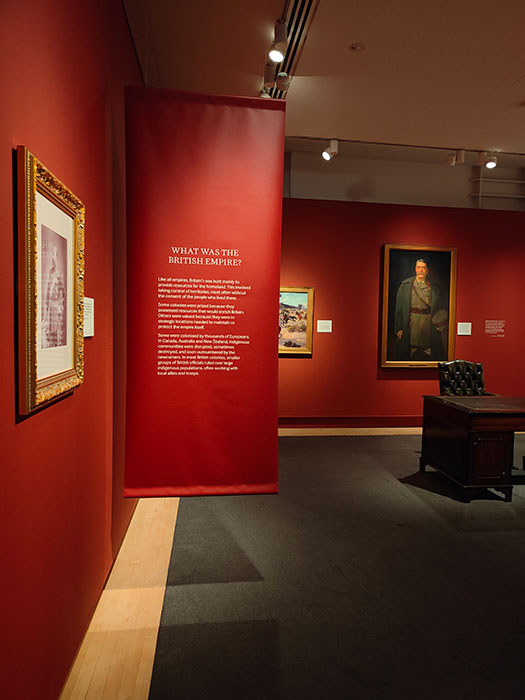
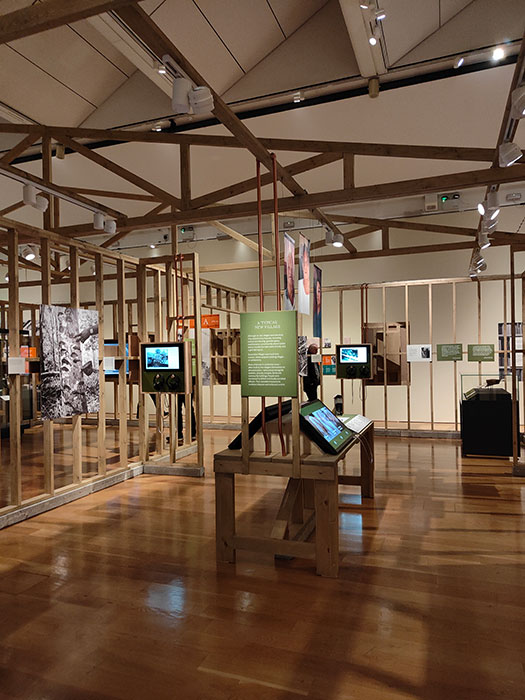
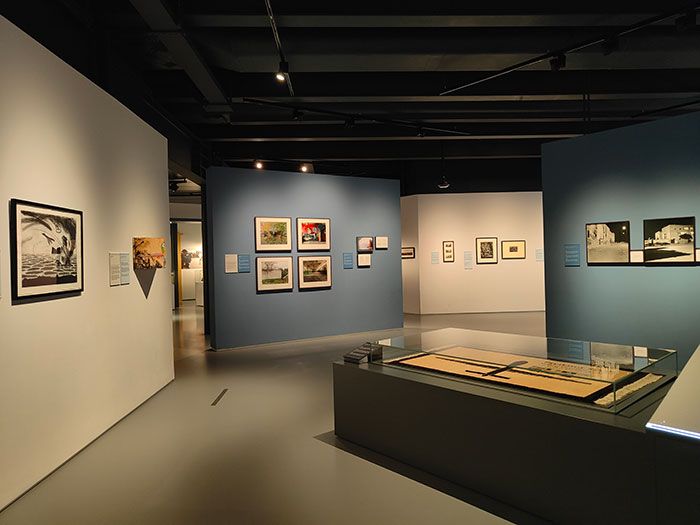
The special exhibition looked into 3 countries that broke free from British imperialism – Kenya, Myanmar, and Cyprus.
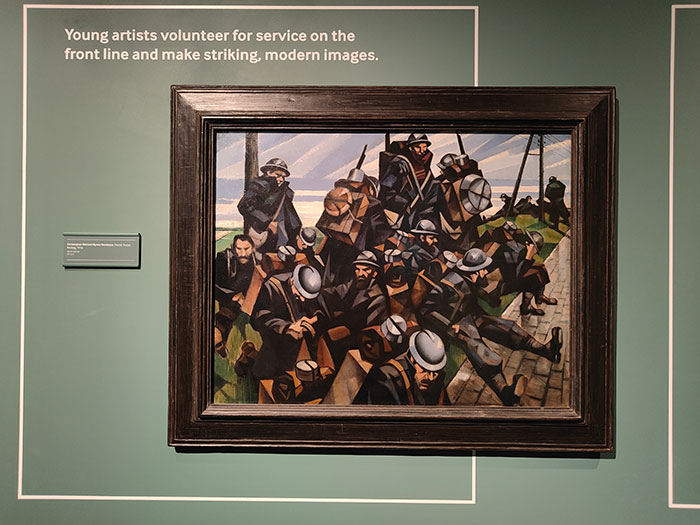
The painting, despite it looking rather modern, was painted in 1916 by Christopher Richard Wynne Nevinson.
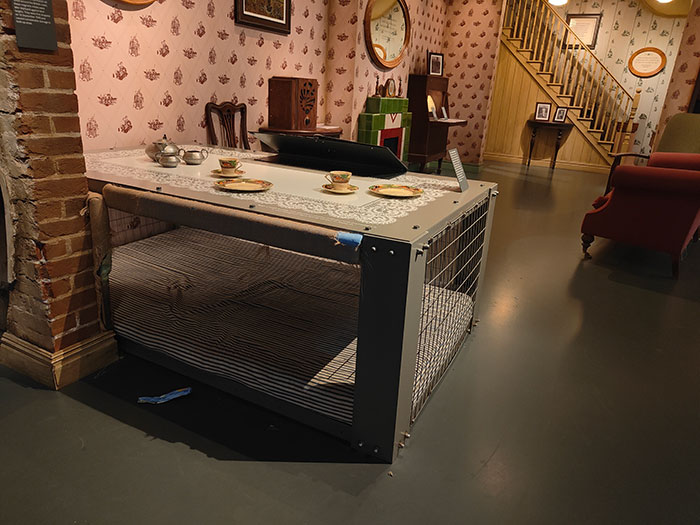
A Morrison shelter, built for indoor use. These were given for free to the population so they could shelter in them if an attack was happening. This structure was strong enough to protect the people in it in case the upper floor would fall on it. The government have tested it before production and distribution and it was effective.
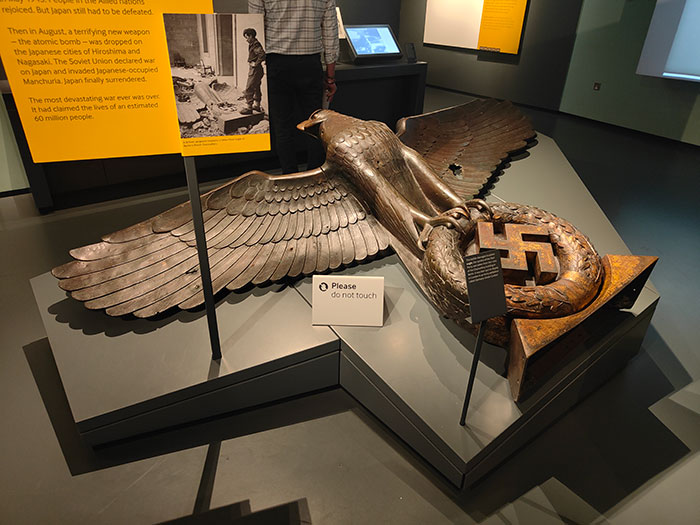
An important artefact, this Nazi eagle was taken from the Chancellery building in Berlin.
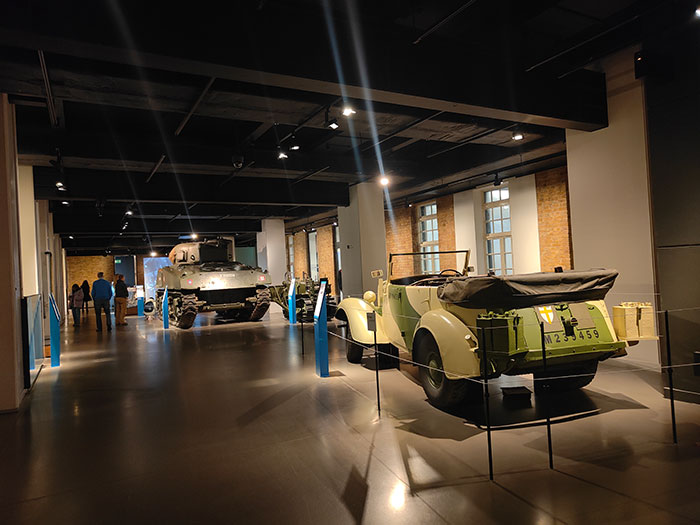
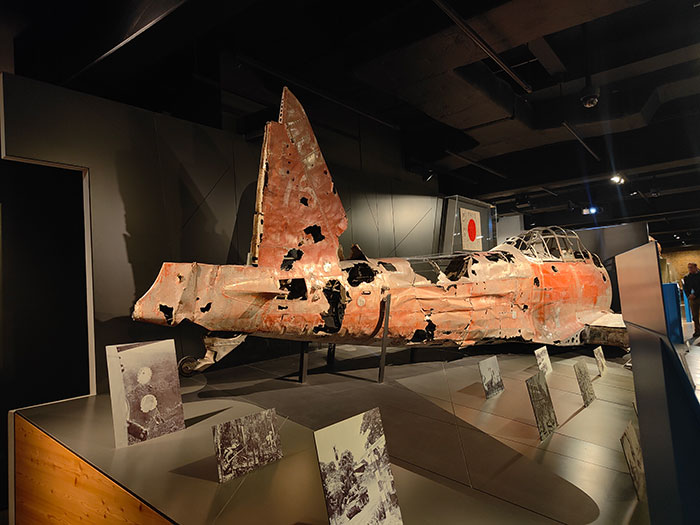
Discovered 50 years after WW2 ended, this is the wreck of a Japanese fighter aircraft. A British bullet was found in the metal. It was an aircraft which was repaired several times before it was taken down.
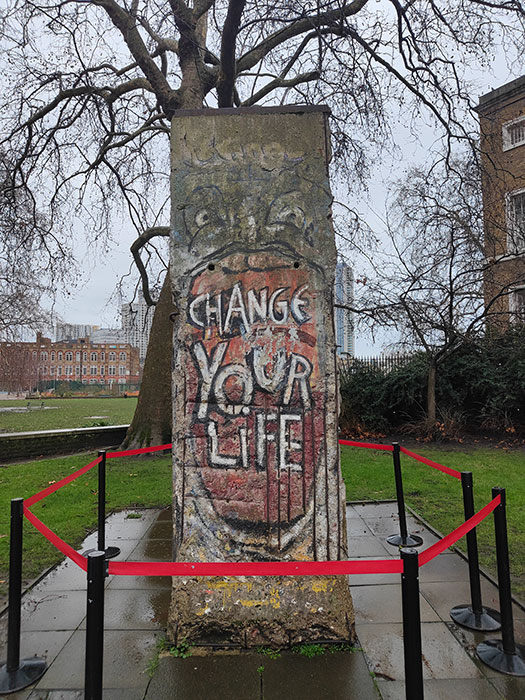
This is a piece from the Berlin wall.


This is one I’ve not been to, Anca, and it looks well worth the visit. I’ve never heard of the Morrison Shelter. That’s pretty cool. (I think they need that in San Francisco/California for earthquakes!
Flora and I went to the Imperial War Museum last Autumn and loved it, but we didn’t experience any noisy children, so I’m sorry that spoilt your visit. Agree with your point about post-1945 not being “peaceful”.
All your photos are very interesting. I’ve never heard of a Morrison shelter. It’s fascinating to see the Nazi eagle.
I’m all for school children visiting museums, but they sure need to be controlled by the adults. I’ve even had teenagers ruin a museum visit.
Kelly recently posted…A photo choice and a song
Why they are allowing children to run around and shout at various items on display? It’s not like the children actually learn anything from that. I had children on tours, when I was volunteering as a guide, and they were interested in the stuff I was saying, as I was avoiding paintings or other grown-up stuff.
I’ve not actually been there though our year 6 kids go. It’s v annoying when kids run wild in these places!