
I mentioned in the round-up from last month that I’ve started language classes and today I’m talking on why I am learning Ukrainian. First of all, me starting last month was not a coincidence. I wanted to learn Ukrainian, but because I had other things in mind, I decided that the right moment is now, after I finished my studies. Learning a new language is difficult and one that involves learning a new alphabet is even more complicated, but that is the attraction in learning it.
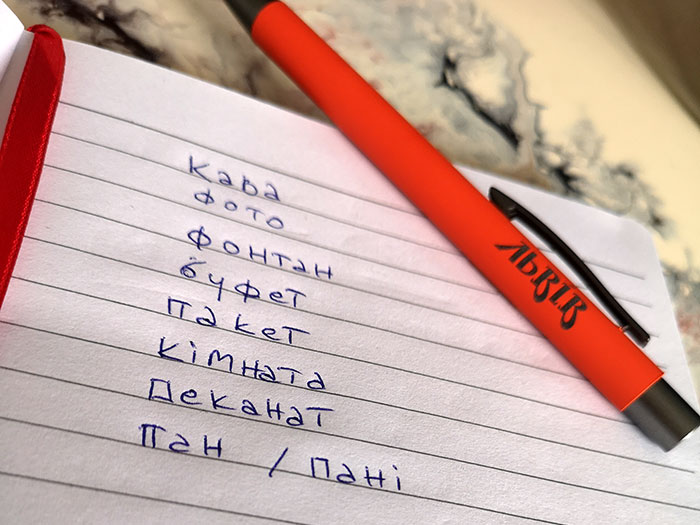
In the picture below is my notebook with a pen I got from Lviv (it writes Lviv on it, even if there are 5 letters). The first word in that list is also the first word I learned while in Ukraine – kava (Latin alphabet) – means coffee! Every adult needs to know this word, of course.
The others in the list are: foto (photo), fontan (fountain), bufet (buffet), paket (package), kimnata (room), dekanat (deanery), pan/pani (Mr./Mrs.).
Reason 1. It’s history
Ukrainian is a descendant of Old East Slavic, a language spoken in the medieval state of Kyivan Rus’. Kyivan Rus was founded in the 800s, while moscow was mentioned in the mid-1100s. By that time, Kyiv was a great city with cathedrals such as Desiatynna (996), St. Sophia’s (1011, where many diplomats are photographed), Vydubychi Monastery (1070), and St. Michael’s Golden-Domed Monastery (1108, where the tanks are displayed today, where there is a memorial for Holodomor, the Heavenly Hundred, and the fallen soldiers from 2014 to today).
Because of this history, the russians tried to ban the Ukrainian language. I say try because they did not succeed. During the Polish–Lithuanian Commonwealth, in the 16th century, when parts of Ukraine were under the rule of Poland, the upper classes learned Polish and changed their religion to Catholic, but the poor people retained both their language and their religion.
In 1654 Ukraine was divided between the Polish–Lithuanian Commonwealth and the tsardom of russia. At that point the russians called Ukrainians and their language little russians. This is the same language used today by russia, showing its imperialistic core. A russian was called “great russian” while Belarusian was “white russian”.
The oppression continued. In 1804 Ukrainian language was banned from schools. In the following decades various centres of knowledge were closed and Ukrainian intellectuals were imprisoned. The russians were referring to Ukrainian as the little russian language in the 19th century. Books were banned, which also shows how much the people of Ukraine wanted to keep their language alive, using it and learning it generation after generation.
Another ban was issued in 1914. In 1918 Ukrainians wanted to gain their independence, have their customs and language. After being forcefully annexed to the soviet union, the language once again suffered. Everything that matter was in russian – schools, universities, government jobs or any kind of good jobs, newspapers and TV, commerce. Even after the fall of the soviet union many kept speaking russian and teaching their children russian.
Some switched to Ukrainian after 2014 while others after 2022, as they didn’t want any connection with russia.
Reason 2. Show my support
Learning Ukrainian is another way to show my support, both morally and financially. I bought an online course made by an Ukrainian, I borrowed books from the library to help me with my learning. This means that the library might decide to buy even more books if they see a demand.
When I get to a stage that I will be able to read and understand properly I will buy a dictionary and some books, most likely I will start with basic books (possibly for children).
Reason 3. Use it in Ukraine
I will visit Ukraine regularly, something I’ve decided on after my trip in April. Many people from the big cities of Ukraine know English and this will improve gradually. President Volodymyr Zelenskyy signed a bill in June of this year which establishes English as one of the languages of international communication in Ukraine. But in smaller cities it is not as wide spread and, of course, even if most of the conversations I will have in Ukraine will be in English, learning a few words and how to read is helpful.
Reason 4. The alphabet
Ukrainians use the Cyrillic alphabet. It has an impressive 33 letters and some sounds that are specific to Ukrainian. It’s safe to say that most people without any background in Slavic languages would find the pronunciation of some sounds a bit tricky. Luckily for me there are a couple which have a similar sound as Romanian letters.
Before starting Ukrainian I imagined it would be difficult to write in Cyrillic and I was right. I will need to do first-grade type of exercises and write the same letter again and again and again. It felt strange at first. But it’s also interesting and a bit fun too. As you can see from the picture, my letters are in dire need of exercise. There are letters which are more complicated, because of their similarity.
Learning a new language is often recommended to older people who are not as actively engaged mentally after they retire. This is because learning languages involves a lot of the brain. Studies showed that bilingual people have a significant delay (of over 4 years) in showing symptoms of Alzheimer and other dementias when compared to people who speak just one language. While this is not something which concerns me at the moment, I think it was worth mentioning in case any of my readers have someone who might benefit from learning a new language. Adding a new alphabet on top of new words is surely keeping the brain active.




I love that you are learning the language and I know it will be very useful on your trips. Americans are woefully bad at knowing other languages, where I find that most Europeans know at least two — perhaps not totally fluently but enough to get by with. I would hope your Romanian upbringing would help make the language a little easier. Thanks for explaining the history of it. I had no idea on that and it was illuminating.
Thank you.
Romanian is a Romance language, like French and Italian, so it’s not very useful to understand Slavic languages like Ukrainian. But it is very interesting to learn and, while I am getting better and better with the alphabet.
This is fantastic! I would love to learn a different alphabet too. I did a Greek language book which was fun to read different letters but I’ve forgotten most of it now, sadly.
I bought a Ukranian phrasebook about 10 years ago but didn’t do much with it though I did take it to school. Our three Ukranian children at school learnt English so well! 2 out the three joined my choir and I was so impressed with their quick learning. x
Kezzie recently posted…TARDIS Tuesday- Donna Noble- the Fires of Pompeii
Good luck! It sounds like there is a lot to learn and it will be so useful for you. x
I admire anyone who studies a new language and taking on a new alphabet is even more impressive. I studied Spanish for six years, but have lost the majority of it. I’m afraid the only way I could become fluent would be by total immersion. Clearly you are aiming for both written and spoken fluency.
Thank you. I can read in a few languages – French, Spanish, Italian – but I can’t speak as I never have the chance to practice. I agree that immersion is very helpful for languages.
With Ukrainian I’m aiming to learn as much as I can. The first stage is to learn how to read, then to understand and speak enough to make myself clear in Ukrainian. I’m not too bothered by grammar and I want to focus on vocabulary.