
This weekend is Mother’s Day, last year it was a couple of days before I adopted Volya. This year I’m back to being a mom to a furry kid. In these past 11 months I had plenty of time to think of the language I use with my pets, what language of love means. When we were living in Romania it was easy, we were speaking Romanian to our pets. With my first dog, Schumy [he was really fast], we had to spell some of the words or talk in code. With our pets, cat Chubbchubbs and dog Festus, we talked in Romanian. Chubbchubbs remained in Romania with my mother, when we moved, as he had some medical issues that meant I couldn’t initially travel with him. After that it was obvious he is more comfortable as an only pet at my mother’s. Language was not something I ever considered, it was the normal mother tongue.
Festus moved with us to the UK. At that point I saw how language was changing. Talking in Romanian with Festus became something I was aware of, from something that was normal. As I volunteered at a dog shelter in the UK, I switched to English, so they could understand me. It became natural to speak in Romanian with Festus and in English with all other pets. This was the norm for over a decade, until I went to Ukraine and started volunteering at the animal shelter there. The language I was speaking was, again, something to consider.
I am speaking Ukrainian for Volya. I wrote in August 2024 that I’m learning Ukrainian. I thought that by being in Ukraine I will learn faster, but I only learned a few words during my volunteering work. I am still a beginner because I didn’t focus on learning as much as I should. With her I am making an effort and speak 90% in Ukrainian. If I don’t know a word, I give a random description – for example “big grass” for “tree”. Now I know the word for tree, so at least that’s sorted.
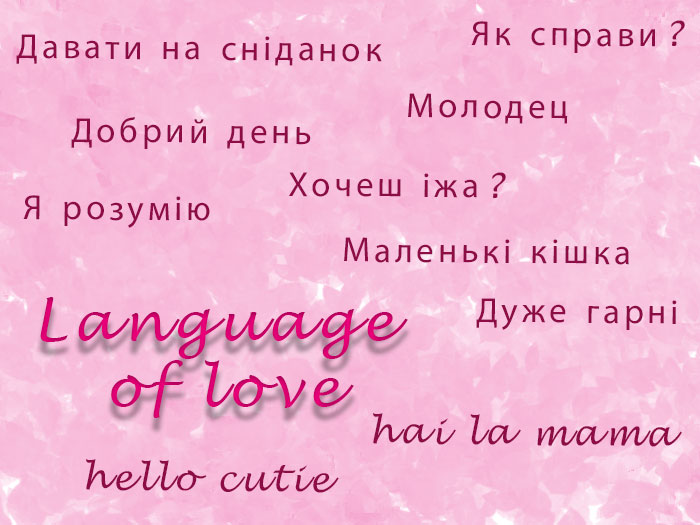
Volya is very vocal. She replies if I greet her, she answers if I ask things like: “how are you?” or “are you ok?”. Of course she knows the words for breakfast and lunch and, if she is hungry, she will meow when she hears “want” before I can finish the sentence. As a cat, is quite impressive that she knows so many words, which is not something we thought is possible. Most of the time she would just ignore us if we don’t speak in Ukrainian to her. Volya is also reacting differently when she hears Ukrainian, music or people speaking. She feels more relaxed. Initially I thought that I am projecting my feelings, but no, she obviously likes hearing Ukrainian. As a Slavonic language it sounds very different than the Romance Romanian or English.
I started learning Ukrainian with very different goals in mind. Now is becoming part of my life in a different way. At night, when Volya is moving around and I call her, even sleepy as I am at that point, I still remember to say to her: Давай [come].





I am FASCINATED by this!!!! I had not thought of what language you might speak to your pets! I love the idea of the language of love!
Ilove that you are speaking to Volya in Ukrainian and that she is hearing the sounds of her homeland as well. She sounds like a smart girl. Smart as well as pretty! I sometimes wonder about Lizzie — if she even knows her own name. She rarely answers to it! But she does know the word “Food!” and also “Birds.” Somehow, she always manages to get what she wants! Happy Mother’s Day!
This is a wonderful post. I remember asking you once if you spoke to Festus in English or Romanian. (or a combination, much like Spanglish)
I know animals understand much of what we say, but I also think tone of voice is as important as the words themselves. I still wish my dogs could answer me in English! There are so many things I want to know.
My husband and I talk in Romglish (although for that we use the “Romanian version” of the word – Romengleză). Tone is important, as it shows our emotions, but language is something dogs understand. There are some limited studies on this, which is a shame, as there should be much more research on this.
For example, Festus understood rather complicated grammar. He would spot an “l” [something similar to him] in a sentence: L-am văzut [I saw him]. We would talk about someone else, in normal voice, and Festus would react. He reacted so many times that we started laughing that now his name is “L”. Maybe that happened because I was talking to Festus, since he was a pup, in regular voice [not baby voice] on different things. He would pay attention, so it was like thinking aloud for me and entertaining for him.
Volya also clearly understands language. I can tell her as many times as I want “come” in English or Romanian. She only comes to Давай. As a cat, she is much more pedantic about these things.
I am impressed – there are days when I call ours by the wrong name, let alone adding language to the mix!
Thank you. Languages make things more entertaining, and complicated, that’s for sure.
Aww! What a lovely read and happy Mother’s Day to you and your fur baby! That is so cool that you are speaking Ukrainian for Volya. She sounds like such a character. x
She has a very strong personality, but she is very gentle and sweet.